Wednesday, 5 August 2015

The world of spiders

Despite the reputation that arachnids have acquired over the years, they are still worthy of a moment of your time should you come across one. At this time of year the long grass that grows in the meadows and fields around the UK provides the perfect habitat for many species of spider.

Some of you may have already seen small clusters of grass tightly bound by a web of sorts. The chances are it will have been the work of the nursery web spider. This species of spider will create a dome-like cover over an egg sac in order to keep it safe until the spiderlings hatch and eventually leave the nest. You can often guarantee that a female will be close by and in some cases will be resting on the side of the web. The guarding spider can be spooked easily and may quickly hide if disturbed. So, being quiet will increase your chances of seeing her.


This nest was found at the edge of the path through the wildlife garden at RSPB Sandwell Valley

A female nursery web spider carrying an egg sac
A recently built nest

A profile image of the nursery web spider    
Another spider that can be seen at this time of year is the Labyrinth spider Agelena labyrinthica. This spider can be identified by the large web carpet that it creates amongst the grass. The web carpet acts as a large catchment area for the spider’s prey. While the spider waits for an unsuspecting insect to cross its web, it will lie in wait in a silk tunnel at the rear of the web. It will then quickly run out and grab its victim before retreating to the confines of it’s silk tunnel to feast on its prey.


My interest with spiders came about when I started photographing in the fields near home. It made me realise how many varieties there are and how they all catch their prey in different ways. Each one has a set of features that enables it to survive in different habitats. I would like to share some of my findings close to home.

The beauty of nature is that it can be found almost anywhere. A great place to start is on the side of your own home. Where there are insects you will find spiders. The sun-warmed surfaces of a building provide a great habitat for the insects attracted to the warmth.

This jumping spider was found, resting in a hollow in the wall, consuming an aphid.    

A nursery web spider basking in the warmth of the sun covered brick   
Commonly know as a jumping spider (Salticus scenicus), this type of spider has exceptionally good eyesight. It will stalk it’s prey to the point where it can eventually leap onto it.

This jumping spider had caught a fly. You can see the large front facing eyes which give this spider the added advantage for hunting its prey. Fully grown, this spider only reaches a size of 5-7mm.


Small holes and cavities provide shelter for these small spiders. So, old buildings can be especially good for spotting them.


Common lace weaver spiders can be found in abundance on buildings. The best time to see this species is at night. Go out with a torch and see if you can find some. Their eyes twinkle as the light passes over them. 


Finding some spiders in long grass can be difficult if they don’t have a visible web. If you know what to look for then you can increase your chances of success.     

Small balls of grass such as this one are evidence.

In this image you can see how difficult it is to notice the spider holding onto the grass in the lower left part of the image.
The spider fastens together multiple pieces of grass and seeds with its silk. This creates a shelter which the spider can blend into. From above, the spider is not visible to predators, so the best way to view this spider is from underneath, where it spends most of its time. 

   
One of my best finds, whilst walking in my local area – garden spiders, Araneidae diadematus, in their juvenile state. The very simple web held two pieces of grass together in an arch form to make a sturdy support for the spiderlings. The ball formation you see in the one picture is referred to as a nursery cluster. The slightest disturbance and the cluster will break apart as the spiderlings disperse rapidly.


I noticed this house spider (Tegenaria gigantic) had made its home in one of the holes on the railway bridge at RSPB Sandwell Valley. Next time you visit have a look and see if you can spot any.


Sometimes you will come across interesting things when you least expect it. This is a green crab spider that I found on the side of my car. It’s the first of the species that I had seen. Luckily I had my camera phone to document it. The green crab spider is one of the most vibrant spiders. It’s thin, translucent body allows it to glow in the harsh sunlight, emphasising its amazing colouration.


A variety of spiders I have documented in my garden 
I hope you have been inspired to explore the world of spiders or at least appreciate them a little more. They are remarkable creatures and play a vital role in the animal kingdom.

Tim Hunt (RSPB Volunteer)


Tuesday, 21 July 2015

The Climate Coalition

My name is David Manning. I am a hide volunteer at Sandwell Valley.  On 17 June I went with 9000 other people from across the UK to lobby parliament about climate change. Along with other RSPB members and likeminded people from organisations like CAFOD and Christian Aid I travelled down by coach to Westminster.  We were all supporters of some of the 100 organisations (including the RSPB) that make up the Climate Coalition.  When we got to Westminster there were inspirational speakers to listen to.  Everyone was so friendly.  The highlight, and whole reason to go, was meeting my MP, Tom Watson. 
The theme of the day was, “Speak Up For The Love Of …..”   Everyone was encouraged to bring bunting showing pictures of things they love and fear will be lost if climate change is not reversed.  My daughter sent me along with four flags showing an orang-utan, an arctic fox, the barrier reef and the Antarctic ice sheet!    If you go onto Tom Watson’s Twitter for 17 June you may still see a photo.  Here’s the link https://twitter.com/tom_watson . I was proud to wear my RSPB polo shirt. Several members came up to speak to me to say hello.
Along with a fellow constituent from Friends of the Earth I asked Tom to press the government to do two things. Things that will make a huge difference to our interconnected world of people and nature:
1.       Make sure the new Sustainable Development Goals agreed in September 2015 respond to the threat of increasing climate change and deliver low-carbon development.
2.       Help agree a global climate deal in Paris this December that requires all countries to take their fair share of action to limit global temperature rise to well below the internationally agreed target of 2°C and support developing countries to cope with escalating climate impacts.

We had a good discussion with Tom.  I hope he understands even better than before that the people in West Bromwich care about our precious planet.  That we want our MPs to ensure it remains a beautiful home for people and nature.  
If you have never taken part in a lobby of parliament before I would strongly recommend it. It’s tiring, it’s a long day – but you feel you are making a difference in solidarity with thousands of people who care about the same things.

If you want to know more about the Climate Coalition just follow this link http://www.theclimatecoalition.org/

Our wildlife garden in July

The last few weeks in the wildlife garden have been particularly colourful. I was really taken aback by the wash of colour that greeted me next to the new visitor centre - I didn’t know where to look first. It was a paradise for insects, especially a whole host of bees. There is something very therapeutic about being surrounded by so much colour and watching the bees going about their business.


It is really worth buying a packet of wild flower seeds and seeing how much colour and insect activity you can bring into your own garden.

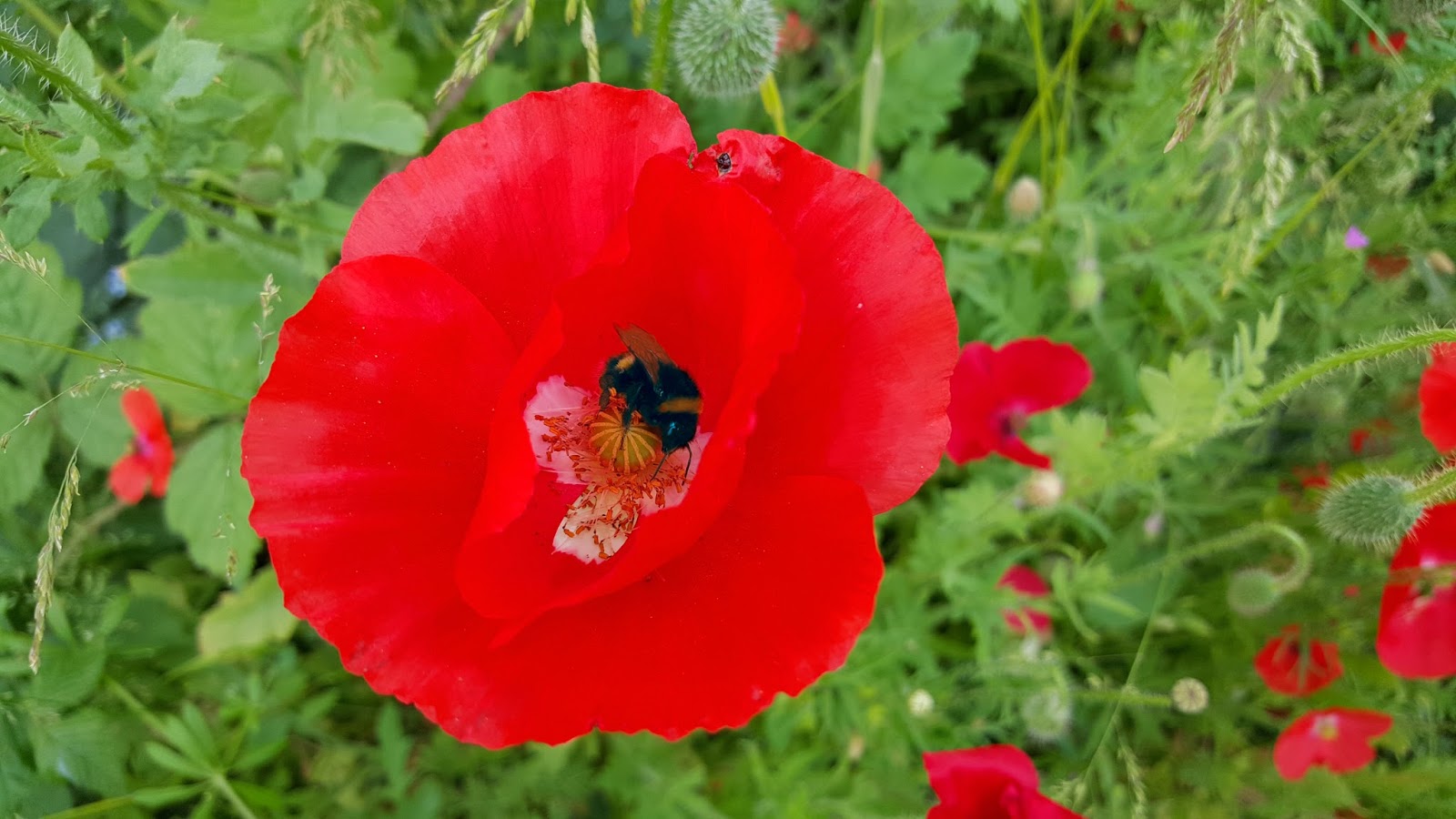
Poppies 
A bee collecting pollen from a poppy
A bumblebee collecting pollen
Ox-eye daisy 
Wood Cranesbill

Some of the creatures you can expect to see

Friday, 1 May 2015

Snap the valley and win a VIP experience!

I have to say, and this is not just because I work here, but Sandwell Valley is looking AMAZING at the moment. A million shades of green are bursting from everywhere and flowers are beginning to emerge adding a pop of colour here and there. The air smells sweet and is alive with busy birds and insects. The fruits of springs labour are beginning to show already with the arrival of 6 very adorable lapwing chicks on our islands this week.

Kate Middleton isn't the only one commanding 'baby fever' this month, our volunteers in the lakeside viewpoint are keeping their eyes peeled for any more new arrivals.

But....the biggest 'delivery' this season is not the imminent appearance of the third in line....it's Natures Reach of course, your brand new RSPB visitor center nestled in the heart of the valley and very nearing completion.

To celebrate this joyous bundle of bricks and mortar we have decided to host a photography competition. There is so much going on, people getting out enjoying the reserve now it's warming up and nature bursting from every nook and cranny. This is the perfect time to start capturing those amazing wildlife moments, spectacular scenery or even your friends and family enjoying their visit.

This is your chance to show us your snaps and perhaps win a prize. We want to see how you see the valley and what makes this place special for you. For me its the small things, the tiny flowers that often go unnoticed or the interesting markings on a tree trunk.

You have until the end of June to take a snap on the reserve and post it on our facebook page https://www.facebook.com/RSPBMidlands OR https://www.facebook.com/BhamBlackCountryWarks and tagging the photo with #Sandwellphoto.

The lucky winner will receive an invitation for two to our very special VIP residents launch event. You will get a 'first look tour' of the new building, and you will have the opportunity to take part in a guided tour and other activities. Or you could just sit back and relax, taking in the views across the valley and indulging in refreshments provided for our special guests. .
Now I am NOT a photographer, but I just popped out to see what I could get with just a spare few minutes and my camera phone, what do you think? - see below!

Basically, you can use whatever equipment you want to snap anything you want on the reserve and share it with us. The public will vote and you could win this exclusive prize.

Go on, have a go!!

Fuzzy bee getting stuck into a dandelion


Stripey insect enjoying the flowers on this garlic mustard flower


Thursday, 16 April 2015

Rudy's Big Bird Watch

Over the Easter weekend, Rudy de Groot a Coventry schoolboy (aged 6) has been undertaking a bird watching marathon in the West Midlands to raise money for Freddie’s Friends, a charity which was set up in memory of Freddie Appleyard, the son of Rachel and Nooley Appleyard, friends of Rudy's family. Freddie’s Friends raises funds for specialist equipment, therapies, toys, short breaks and any help possible for local children in and around Hull with disabilities, life limiting illnesses and organisations associated with disabled children.
In the hide at RSPB Sandwell

Rudy put his newly developed bird-watching skills into practice at a number of West Midlands' bird watching sites over the weekend - at Coombe Abbey Park and Brandon Marsh in/near Coventry, and the RSPB sites Middleton Lakes, and Sandwell Valley. Rudy says: 'I absolutely love bird watching - it's so exciting - and I'm getting really good at identifying all the different species! I always try and spot something I've never seen before and I love visiting all the different hides at each site. It's a brilliant and fun way to raise money!'​. As well as being sponsored by many people to visit all four sites, Rudy’s corporate sponsor, MP Locums, sponsored him £10 per species spotted so there was a lot at stake in finding as many birds as possible! Here’s Rudy and his mum Helen’s account of their visit to the RSPB sites:

At Middleton Lakes, we undertook a massive walk around this sprawling RSPB reserve and were rewarded with a bumper crop of bird sightings (47 species spotted in total). We started well with spotting our first Chiffchaff very near the carpark at dawn, swiftly followed by our first Song Thrush. In the woods I hand-fed a very friendly robin and Rudy shared his trail mix with two nuthatches. We saw a tiny treecreeper in the wood too and a resplendent pheasant with his two 'wives'. After a long walk to Middleton's very posh Top Hide, we were assisted by friendly birders who helped us to spot some avocet, a little egret, goosanders, pintails, little ringed plovers and a couple of Mediterranean Gulls, amongst other birds.

Moving on to Sandwell Valley (which richly deserves its title as a inner city birding oasis), and despite the fact that we were flagging after a weekend of walking and watching, we were greeted warmly by Alex and the RSPB staff at the visitor centre. Alex had a bag of sweets waiting for Rudy and a very welcome sugar rush got him back on his feet. We were also pleased with the tipoff she gave us about the feeder where we could find bullfinches and we went straight there to find two males sitting in a bush waiting for us.


The hide on site was the friendliest we had visited so far – volunteers were on hand to help casual birders and even provide teas and coffees! Even though it was difficult to add new birds to our total at this stage in the weekend (we had already seen shovelers, teal, heron, great crested grebes, and oystercatchers – though very exciting to hear about their eggs!!) we added a pied wagtail and a starling to our total. Another long walk around another lake saw our final new spot of the day: two swallows diving around on the bank of the river opposite the hide (our first of the season). Sadly, the famous Sandwell parakeets were nowhere to be seen, nor did we see any kingfishers, but we had a fantastic time and have raised a lot of money thanks to everyone's generosity (£1570 so far). There is still time to donate via our Just Giving site: https://www.justgiving.com/rudysbigbirdwatch - we have been absolutely blown away by the generosity of other bird watchers that we’ve met this weekend.

Here’s our full list – the letters after indicate which of our four sites the birds were seen at:


Avocet (M); Blackbird (C, M); Black Cap (C); Black Headed Gull (C, B, M); Blue Tit (C, B, M, S); Bullfinch (S); Buzzard (M); Canada Goose (C, B, M, S); Carrion Crow (C, B, M, S); Chaffinch (C, B, M); Chicken (B); Chiffchaff (M); Coal Tit (C); Common Gull (C, B, S); Coot (C, B, M, S); Cormorant (B, M); Dunnock (C, B, M); Egyptian Goose (C); Feral Pigeon (C); Gadwall (B, M, S); Goldeneye (B); Goldfinch (M); Goosander (M); Great Black Backed Gull (B); Great Crested Grebe (C, B, M, S); Great Spotted Woodpecker (C, M); Great Tit (C, B, M, S); Greenfinch (M); Green Sandpiper (B); Green Woodpecker (C); Grey Heron (C, M, S); Greylag Goose (C, B, M); Jackdaw (C); Jay (C, M, S); Kestrel (B, M); Lapwing (B, M, S); Lesser Black Backed Gull (B, S); Little Egret (M); Little Grebe (B); Little Ringed Plover (M, S); Long Tailed Tit (B, S); Magpie (C, B, M, S); Mallard (C, B, M); Marsh Tit (C); Mediterranean Gull (M); Moorhen (C, B, M, S); Mute Swan (C, B, M, S); Nuthatch (C, M); Oystercatcher (B, M, S), Pheasant (B, M); Pied Wagtail (S); Pintail (M); Pochard (B, S); Redshank (B, M); Reed Bunting (C, B, M); Robin (C, B, M, S), Raven (C, B, M, S); Rook (M); Shelduck (B); Shoveler (B, M, S); Song Thrush (M); Starling (S); Swallow (S); Teal (B, M, S); Treecreeper (M); Tree Sparrow (M, S); Tufted Duck (C, B, M, S); Willow Tit (C); Wood Pigeon (C, B, S); Wren (M)

Sunday, 5 April 2015

National construction company helps out local nature reserve

Workers from UK construction company, Cold Clad, were on hand recently to help out the RSPB at Sandwell Valley near West Bromwich.

During the construction of the new visitor centre, work was held up by damage that had occurred to one of the storage buildings at the site.

Holly Booker, RSPB representative, said “Our insulated storage building was damaged some months ago by vandals and we needed it to be fixed before building work could continue. This is exactly the kind of building that Cold Clad are experts in constructing, so they were able to mend it for us at no cost to the charity. We are extremely grateful for their contribution to our work.”

Some of the damage
All repaired

A poem of thanks, from rspb Sandwell Valley

In a quiet corner of the valley, known to most as Sandwell,
Is a special place where foxes and frogs and bugs and birds do dwell.

A place where locals come to unwind, relax and walk,
Where the bumblebees buzz and the birds sing and squawk.

We’ve been working hard for many years to give wildlife a home,
A place to explore and discover and where wildlife is free to roam

To make your visit even better, we’ve been busy in recent weeks,
Building a brand new visitor centre, we’ve called it nature’s reach.

Sadly, our progress has been a bit set back,
Someone came along and gave it a thwack, crack and whack

Maybe they though (we like to think) they were helping us out,
But some damage was caused when they gave the building a clout

The damage was a nuisance and came with a hefty bill,
How would we fix our building on top of the hill?

In the last week of February, to our surprise and delight,
Some people came to the rescue, a real life shining Knight.